pydocs-mcp Benchmark Suite¶
Real retrieval-quality evaluation for pydocs-mcp against public benchmarks —
RepoQA-SNF (arXiv:2406.06025) and DS-1000 (CodeRAG-Bench flavor,
arXiv:2211.11501 / arXiv:2406.14497) — measured head-to-head against
Context7 and Neuledge Context, with JSONL- or MLflow-backed experiment
tracking.
Its purpose: A/B-test YAML pipeline tunings (AppConfig) on real benchmarks and
record every (system × config × dataset) combination as one tracked run with
comparable params, metrics, and artifacts.
Beyond retrieval scoring, the same package hosts the skill/prompt optimization
loop (src/pydocs_eval/optimize/): candidate guidance skills are evaluated
across datasets and task types and accepted only on paired statistics —
treating retriever configs and search-guidance text as the two trainable
parameter spaces of one system.
For a ready-to-run comparison of BM25 / dense / hybrid (RRF + weighted) / tree
retrieval strategies on a small RepoQA slice (--split small_test), see
EXPERIMENTS.md.
How the systems compare (qualitative)¶
pydocs-mcp, Context7, and Neuledge Context all feed docs to an AI agent over MCP, but optimize for different things. They aren’t mutually exclusive — an agent can mount all three and route by intent. This table is the qualitative side; the rest of this document is the same three systems scored head-to-head on identical tasks and gold answers.
pydocs-mcp |
Context7 |
Neuledge Context |
|
|---|---|---|---|
Deployment |
Local stdio MCP server |
Hosted MCP ( |
Local stdio MCP server |
Doc source |
Your installed Python deps + your own project, indexed in place |
Curated community docs hosted by Upstash |
Community registry (~100+ libraries), pulled then queried locally |
Version match |
Exactly what’s in your |
Library + version chosen in the prompt |
Latest from the registry |
Languages |
Python |
Multi-language |
Multi-language (~100+ libraries) |
Retrieval |
Keyword (BM25) + dense embeddings + LLM tree reasoning, fused via RRF or weighted scores; optional late-interaction (ColBERT-style) and reference-graph expansion |
Not publicly documented |
BM25 over SQLite FTS5 |
Code-structure queries |
Reference graph — |
None (doc retrieval only) |
None (doc retrieval only) |
Indexes your code |
Yes — under the |
No |
No |
Privacy |
Fully offline with the default embedder — zero network calls |
Queries hit Upstash; OAuth + API key |
Local once packages are downloaded |
Dependencies |
Lean — no PyTorch, no FAISS (Rust TurboQuant store + small ONNX embedder) |
Hosted service (nothing to install) |
Local service |
Cost |
$0 — OSS (MIT); no keys, limits, or fees |
Free tier (rate-limited) + paid plans |
$0 — OSS (Apache-2.0) |
In short: choose pydocs-mcp for offline, version-matched Python retrieval where you also navigate code structure; Context7 for hosted, multi-language docs; Neuledge for a local-first multi-language registry.
        flowchart TB
    DS["Dataset loader<br/>(RepoQA · DS-1000)"]
    SPLIT["stratified dev/test split<br/>by repo / library"]
    TASKS["EvalTask<br/>query · gold · corpus · metadata"]
    DS --> SPLIT --> TASKS

    subgraph SUT["system under test  ×  config overlay"]
        direction LR
        PM["pydocs-mcp<br/>ranked"]
        PC["pydocs-mcp-composite<br/>single blob"]
        PO["pydocs-oracle<br/>library-documentation"]
        C7["Context7"]
        NL["Neuledge"]
    end

    TASKS -->|"index(corpus) · search(query)"| SUT
    SUT --> RET["RetrievedItem(s)"]

    GR["GoldResolver per system<br/>eager-fuzzy · oracle exact-doc_id · lazy-fuzzy"]
    RID["resolved_chunk_ids"]
    RET --> GR
    TASKS --> GR
    GR --> RID

    ISREL["is_relevant(item, task)"]
    RID --> ISREL
    RET --> ISREL

    METRICS["metrics<br/>recall@k · precision@1 · mrr<br/>ndcg@k · coverage · library_resolution@1"]
    REPORT["report → trackers<br/>(jsonl · mlflow)"]
    PLOT["plotting → PNG"]
    ISREL --> METRICS --> REPORT --> PLOT
Each run fans a dataset’s tasks across one or more systems (each under a config
overlay), resolves ground truth per system, then scores every system on the
same relevance signal. That shared signal is the core design choice — it is
what lets a cloud API (Context7), a local HTTP service (Neuledge), and an
in-process pipeline (pydocs-mcp) be measured with one metric suite. See
Metrics for how it works.
Metrics¶
Every (system × config × dataset) run reports the metrics below per task, plus
an aggregate value with a 95% bootstrap confidence interval (1000 resamples,
seed=0). The aggregator lives in
benchmarks/src/pydocs_eval/metrics/aggregate.py.
How relevance is decided¶
A single predicate — is_relevant(item, task), in
benchmarks/src/pydocs_eval/metrics/_relevance.py — backs every metric, so
none of them branch on the dataset. It picks one of two definitions from the
shape of the gold answer:
RepoQA gold carries an AST body → relevance is an AST-equivalence match (whitespace- and comment-tolerant), in
benchmarks/src/pydocs_eval/ast_match.py.DS-1000 gold carries doc contents / doc-IDs → relevance is set membership in the per-task
resolved_chunk_idsset.
That set is populated, before metrics run, by a per-system GoldResolver
(benchmarks/src/pydocs_eval/gold_resolver.py): native pydocs-mcp
fuzzy-matches each indexed chunk against the gold doc contents (rapidfuzz
partial_ratio, threshold 85); pydocs-oracle matches each chunk’s preserved
doc_id exactly; Context7 and Neuledge — whose stores cannot be enumerated —
lazily fuzzy-match only the blob they actually returned.
The metrics¶
Metric |
What it measures |
|---|---|
|
|
|
The retrieval literature’s name for exactly the quantity above — averaged over instances it is “the proportion with at least one gold item in the top- |
|
Mean average precision at |
|
|
|
Mean reciprocal rank — |
|
Binary-relevance normalized discounted cumulative gain over the top- |
|
|
|
|
|
|
recall@kis not fractional recall. It never was — it returns a per-instance1.0/0.0, so the run-level number is a hit rate.hit@kexists only to say that out loud; adding it changed no measurement, and no recorded number moved. The metric that IS fractional in this suite is the optimization track’sgold_recallcheck, which scores the fraction of gold candidates appearing in an answer — a different track, a different input.
Not every metric fits every run. Single-item systems (Context7, Neuledge,
and pydocs-mcp-composite) return one text payload per query, so only the
rank-1 family (recall@1, hit@1, precision@1) is defined for them; the
ranked metrics (recall@5/10, hit@5/10, map@5, ndcg@10, mrr) need a
top-k list. The
DS-1000 runs show which metric set
goes with which output shape.
Datasets¶
One subsection per benchmark, each answering the same four questions — what it tests, an example task, size + source, and what it does (and does not) proxy — so adding a benchmark is a copy-paste of the shape, and a reader can calibrate how much weight to put on the numbers.
The harness deliberately uses external benchmarks with stable gold answers. An earlier placeholder that synthesized queries from the chunks it had just indexed was removed: a chunker change shifted corpus and queries together, so the eval was blind. RepoQA and DS-1000 gold answers cannot be influenced by the system under test.
RepoQA-SNF (Python subset of repoqa-2024-06-23)¶
What it tests: natural-language description → Python function retrieval in
long, real-world code repositories. Each task hands the system under test a
multi-file repo slice and a one-sentence English description of one function
(“the needle”); the system returns a ranked list of candidate chunks; the
harness counts whether an AST-equivalent match of the needle’s body appears in
the top-K. This is the dominant query shape for search_codebase(query, kind, ...)
on the MCP surface.
Example task (from
benchmarks/tests/fixtures/repoqa_mini.json, the 5-needle fixture shipped
for hermetic CI):
Query (description):
    Compute the factorial of a non-negative integer.

Repo content (file path → source, pinned to a specific commit):
    fixture_repo/__init__.py
    fixture_repo/math_helpers.py
    [in production tasks: 30–80 real Python files per repo]

Gold answer (AST-matched, comments + whitespace tolerant):
    def factorial(n: int) -> int:
        if n <= 1:
            return 1
        return n * factorial(n - 1)

Other needles in the same repo:
    - fibonacci  — Compute the n-th Fibonacci number.
    - is_prime   — Test whether n is prime.
    - gcd        — Greatest common divisor of two integers.
    - lcm        — Least common multiple via gcd.
A “pass” on recall@k means at least one of the top-K retrieved chunks contains
a function whose AST body matches the gold needle’s (the
relevance predicate handles the match);
pass@1-needle is the same check restricted to rank-1; mrr rewards ranking
the gold high.
Dataset size: 100 needles total — 10 real Python repos (HuggingFace
Transformers, vLLM, FastAPI, sympy, …) × ~10 needles each. The shipped fixture
(repoqa_mini.json) has 5 needles across two synthetic repos for hermetic CI
runs that don’t touch the network.
Source: Liu, J. et al. RepoQA: Evaluating Long Context Code Understanding.
arXiv:2406.06025, June 2024. Apache-2.0, by the EvalPlus team. Downloaded on
first run to ~/.cache/pydocs-mcp/repoqa/ and cached thereafter.
Proxies well: description → function retrieval (the 1:1 shape matches MCP
search); long-context indexing on real Python layouts; A/B testing of YAML
tunings against a fixed dataset + metric set; cross-system retrieval comparison
(pydocs-mcp vs context7 vs neuledge on identical queries + gold).
Does NOT proxy: end-to-end LLM code-generation quality (retrieval only); multi-file / call-graph retrieval (each task is single-needle); library-docs lookup from an intent (RepoQA describes a function inside a specific repo — DS-1000 covers the intent → docs loop); multi-language coverage (Python only).
DS-1000 (CodeRAG-Bench flavor)¶
What it tests: natural-language data-science intent → library-documentation retrieval. Each task hands the system a StackOverflow-derived problem stripped of its solution (“How do I group a DataFrame and take the mean of each group?”) and asks for the library documentation a developer would need. The harness checks whether the gold doc(s) — manually verified canonical doc-IDs — appear in the retrieved set. This exercises the “look up the right API doc from an English question” loop directly, complementing RepoQA-SNF’s function-inside-a-repo shape.
Example task:
Query (NL intent, solution stripped):
    I have a DataFrame and I want to group by one column and compute the
    mean of another column for each group. How do I do that in pandas?

Gold answer (canonical library doc, matched by content or doc-ID):
    pandas.core.groupby.GroupBy.mean — Compute mean of groups, excluding
    missing values. (doc_id: pandas.core.groupby.GroupBy.mean)

Library: pandas   Perturbation bucket: Origin
Dataset size + source: 1,000 problems across seven Python libraries (NumPy,
pandas, SciPy, Matplotlib, scikit-learn, TensorFlow, PyTorch), from Lai et al.,
DS-1000: A Natural and Reliable Benchmark for Data Science Code Generation
(arXiv:2211.11501, 2023). The retrieval framing — gold doc-ID annotations plus a
documentation datastore — comes from Wang et al., CodeRAG-Bench: Can Retrieval
Augment Code Generation? (arXiv:2406.14497, 2024). The loader pins a Hugging
Face revision for reproducibility; a small hand-crafted fixture
(benchmarks/tests/fixtures/ds1000_mini.json) lets hermetic tests run
without network access.
Proxies well: NL intent → library-docs retrieval (the loop RepoQA does not cover); version-sensitive indexing (the pinned reference project measures whether indexing the correct library release matters — a differential version-agnostic services cannot show); retriever-vs-chunker attribution (the oracle-indexing run separates retrieval quality from chunking quality).
Does NOT proxy: exhaustive relevance (gold is a verified subset of valid
docs, so scores are a lower bound — a “miss” may be a valid alternative the gold
omits); broad library coverage (only the seven libraries); robustness to query
perturbation (DS-1000 perturbs the solution code, not the retrieval target, so
scores stay roughly flat across buckets — flatness is not a robustness signal);
paraphrase-heavy gold (the fuzzy threshold of 85 is conservative and YAML-tunable;
heavily paraphrased docs may score 0.0 under content matching — this applies
only to the native source runs; the canonical oracle run matches gold by exact
doc-title, so it is unaffected).
RepoQA-structural (reference-graph split)¶
A derived split that stress-tests structural retrieval — the code you reach by
following the call / inheritance graph, not by matching text. Built from RepoQA by
scripts/build_structural_recall.py: for
each needle it keeps the original natural-language description as the query but
swaps the gold to a 1-hop reference-graph neighbour (a caller, a callee, or an
overriding subclass method) that is not the dense top-1, while requiring the
needle itself to be in the dense top-K — so the neighbour is reachable by seeding
graph expansion from a dense hit.
What it measures. Whether the
graph_expandretrieval step recovers structurally-adjacent answers a dense embedder misses (its text doesn’t match the query, but it calls / is called by / overrides a function that does).Gold. The neighbour’s function body, AST-matched (same scorer as RepoQA).
Registered as
repoqa-structural(datasets/structural_recall.py). The fixture (fixtures/structural_recall.json) is a thin overlay — repo source is reconstructed from the cached RepoQA release at eval time, so it stays tiny (no duplicated repo trees).Run it. See EXPERIMENTS.md §6 for the generate + compare commands.
SWE-QA-Pro (primary code-QA track)¶
What it measures. Repository-level code-comprehension questions →
file-level retrieval. Each task hands the system a real Python repo pinned to a
commit and a natural-language question about it (“How does the variational QAOA
model override the minimize method?”); the system returns ranked chunks, and the
harness checks whether the file(s) the gold answer cites appear in the retrieved
set. This is the dominant query shape for get_context / search_codebase on
whole real-world codebases (not single needles).
Dataset size + source. 260 QA pairs over 26 Python-only repos (10 each), MIT, from
TIGER-Lab/SWE-QA-Pro-Bench(arXiv:2603.16124). Each row carries a full 40-hexcommit_id, aqa_type(What / Where / How / Why + 12 sub-classes), aclusterid, and near-regular(path.py: line N-M)answer citations (96% of rows). Pinned at dataset revision596892da….Gold. File-level pseudo-qrels: the answer’s path citations, resolved against the pinned repo’s file tree, become
GoldAnswer.file_set. Rows whose answer cites no resolvable file are dropped with a logged count (no silent caps). Registered asswe-qa-pro(datasets/swe_qa_pro.py); the committed mini fixture (tests/fixtures/swe_qa_pro_mini.jsonl) drives hermetic CI without network access.Per-category reporting. Because every row is tagged with a
qa_type, the report grows a## By qa_typebreakout (What / Where / How / Why) whenever ≥2 categories are present — this is why SWE-QA-Pro is the primary track for per-category analysis. Once decision capture lands, the 65 Why rows also feedget_why’s acceptance probe.Run it.
# Config zoo (dataset-free overlays; --dataset picks the campaign):
# benchmarks/configs/{bm25,dense,hybrid_rrf_k60,dense_graph}.yaml
python -m pydocs_eval.runner \
    --dataset swe-qa-pro \
    --configs benchmarks/configs/bm25.yaml,benchmarks/configs/hybrid_rrf_k60.yaml
The loader fetches the pinned
data/test.jsonlinto~/.cache/pydocs-mcp/swe-qa-pro/and clones each repo pin into the shared~/.cache/pydocs-mcp/swe-qa-repos/on first run, then reuses both caches. Corpora are redistributed-by-download — cloned into the cache, never committed (they belong to their authors).
Pseudo-qrel caveat — the same caveat governs both SWE-QA corpora, so read it once here:
The datasets ship QA pairs, not qrels, so retrieval evaluation derives pseudo-qrels: a file/symbol is relevant to a question iff it is cited in the gold answer (path and dotted-name extraction with normalization). This is a documented approximation — good for comparing our own configs on nDCG@10, recall@{5,10,20}, MRR; not publishable as absolute IR quality.
SWE-QA (secondary code-QA track)¶
What it measures. The same repository-level code-QA → file retrieval shape as SWE-QA-Pro, on a larger but noisier corpus. Complements SWE-QA-Pro with more repos and more questions, at the cost of coarser labels and no per-question taxonomy.
Dataset size + source. 720 QA pairs over 15 Python repos, Apache-2.0, from
swe-qa/SWE-QA-Benchmark. The HF release columns arequestion+answeronly — the repo is inferred from the split name, and there are no commit pins in the data. Pins (short SHAs) live in the companion GitHub repo (peng-weihan/SWE-QA-Bench,repo_commit.txt) and are transcribed into the adapter’s_REPO_PINS. It is unverified that the 720-row release was built against exactly those commits, so labels stay file-level for this corpus (safe under line drift). Pinned at dataset revision07e206aa….Gold. File-level pseudo-qrels, same extraction as SWE-QA-Pro; citations are noisier (~8% bare filenames resolved by unique basename), citation-free rows drop with a logged count. Registered as
swe-qa(datasets/swe_qa.py); the committed mini fixture (tests/fixtures/swe_qa_mini.jsonl) drives hermetic CI. There is no per-question taxonomy in the release, so per-category breakouts come from SWE-QA-Pro; SWE-QA gets per-repo breakouts only.Run it.
# --split selects one repo (e.g. matplotlib) or "default" for all 15.
python -m pydocs_eval.runner \
    --dataset swe-qa \
    --configs benchmarks/configs/bm25.yaml \
    --split matplotlib
The loader fetches the per-repo
data/<repo>.jsonlfiles into~/.cache/pydocs-mcp/swe-qa/and clones each pin into the shared~/.cache/pydocs-mcp/swe-qa-repos/on first run. Corpora are redistributed-by-download — never committed.
The pseudo-qrel caveat above applies identically to this corpus — comparative, not absolute, IR quality.
Airgapped corpus (prewarm)¶
The crosscommitvuln dataset pins each task to one repo at one pre-fix commit and
materializes that snapshot lazily via RepoCache
(datasets/_repo_cache.py) — which
normally needs network at eval time. To run the eval offline after a
one-time prewarm:
# 1) ONCE, with network: build one <repo>.bundle per pinned repo into a local
#    cache dir (default ~/.cache/pydocs-mcp/crosscommitvuln-bundles).
PYTHONPATH=benchmarks/src \
    python benchmarks/tools/prewarm_crosscommitvuln_corpus.py

# 2) Thereafter the loader auto-detects that dir and runs OFFLINE — no network.
#    Point elsewhere (or a second machine) with the env var if you moved it:
export PYDOCS_CCV_BUNDLE_DIR=~/.cache/pydocs-mcp/crosscommitvuln-bundles
python -m pydocs_eval.runner --dataset crosscommitvuln --configs benchmarks/configs/bm25.yaml
When PYDOCS_CCV_BUNDLE_DIR (or the default dir) exists, CrossCommitVulnDataset
constructs a bundle-aware RepoCache that clones each base from its local bundle
instead of the URL; when it is absent, behavior is unchanged (lazy network clone).
The bundles live only in that user cache dir — no third-party repo source is
ever committed or shipped in the wheel. swe-qa / swe-qa-pro are unaffected:
they construct RepoCache() with no bundle dir and keep the network path.
Cache-key change. Repo cache dirs and bundle filenames are now
<repo>-<8 hex of sha256(url)>, because the bare repo name collided across orgs (orgA/utilsandorgB/utilsshared one base clone AND one bundle). Existing caches and bundles are orphaned, not corrupted: base clones are re-cloned on next use, and stale.bundlefiles should be re-prewarmed (or deleted) since nothing reads them under the old names.
Re-run the prewarm after adding records. The skip is content-aware: a repo is
skipped only when its bundle already carries every commit the records pin for it,
so a repo that gains a second CVE (or whose bundle is corrupt) is rebuilt rather
than trusted. That step needs network again, for the changed repos only. A
bundle-sourced clone keeps origin pointed at the real URL, so a commit the
bundle happens to lack is still fetched normally on a networked machine — and in
a true airgap that fetch fails loudly instead of silently doing nothing.
Bug localization (swe-bench-verified-loc + lca-bug-loc)¶
What it measures. File-level bug localization: given a bug or issue report plus a repository snapshot, name the file(s) that must change. The gold is a set of repo-relative paths and nothing else — no symbol, no body — so this is the purest cross-file retrieval task in the suite. Caumartin, Chen and Costa, arXiv:2607.11046 (2026).
Where the data comes from. Two registered datasets, both pinned to a
content-addressed HuggingFace revision and both minting under the one bug_loc
task name:
Dataset |
Instances |
Gold |
License |
|---|---|---|---|
|
500, Python |
the fix patch’s non-test files (mean 1.25, median 1, max 21, 85.8% single-file) |
none declared on the dataset card; the SWE-bench project code is MIT (arXiv:2310.06770) |
|
50, Python |
the record’s |
Apache-2.0 |
Both gold profiles are derived — this suite’s own diff reader and test-path
predicate over the pinned revisions — not quoted from the paper, which does not
state the convention behind its own means, so the two are not comparable without
checking it. The lca-bug-loc figures are corroborated against the release’s own
changed_files_without_tests_count, which they match on 50/50 rows.
Long Code Arena also publishes Java and Kotlin slices of the same size. They are deferred, not dropped: those extensions are outside the indexer’s allowlist ceiling, so the snapshots cannot be indexed at all, and widening that ceiling is a product-side event (a registered chunker per extension plus an allowlist amendment), not a dataset edit.
Which metrics. hit@5 is the paper’s primary number and map@5 its
rank-sensitive companion; both are also worth reading at k ∈ {1, 10}. Both
count k in chunks, not files — the paper’s k is a file budget, but our
systems rank chunks and every ranked metric in this suite truncates that chunk
list, so a hit@5 here is a stricter budget than the paper’s Hit@5 on any
system returning several chunks per file. Read them against each other (they
share one rank space, so map@k > 0 always implies hit@k == 1), and against
the paper only with that caveat stated. Neither
is in the default --metrics set — that ordering is walked top-to-bottom by the
regression-diff scripts, so adding to it would reshape every existing report;
pass them explicitly (--metrics hit@1,hit@5,hit@10,map@5) for a bug_loc sweep. The paper’s
third measure — representation footprint, the token volume of the index a
representation produces — is a COST measure rather than a retrieval-quality one
and is not implemented: it scores an index, not a (query, ranking) pair,
so it has no home in the metric protocol and would need an index-side probe.
Corpus acquisition. Every instance pins a different repository, so each task
checks its own commit out through the shared repo cache and materializes a
history-less copy — redistributed-by-download, never committed. Two costs worth
planning for: swe-bench-verified-loc is the first ~500-pin consumer (12 base
clones, up to 500 retained worktrees of repos the size of django and sympy — use
--max-tasks on a small disk), and these two datasets materialize a wider
corpus than the rest (the indexer’s default extension set, not Python only)
because a fix patch routinely touches .rst, .cfg and .toml, and a gold file
absent from the corpus would score a guaranteed miss. Every other dataset keeps
its Python-only corpus byte-for-byte, so no recorded baseline moves.
Resolving either release needs pip install "pydocs-mcp-eval[datasets-parquet]"
(these corpora publish parquet only); the test suite needs neither wheel.
Agent track (paired agent-efficiency, manual — never CI)¶
What it measures. Not retrieval quality, but agent efficiency at answer
quality parity. The same headless coding agent answers repository questions
twice per task: once with bare file/search tools (Read / Grep / Glob /
Bash), once with the pydocs-mcp server attached. A blind LLM judge scores both
answers against the gold answer, and the report aggregates the cost / wall-clock
/ turn / tool-call / file-read / cache-token deltas per task, paired — so the
efficiency numbers are honest only where the two arms scored at quality parity.
This is manual and expensive by design — it never runs in CI. A full run
spawns a real headless agent per arm and spends real money (~$5–10 per arm per
repo). Everything pure and Protocol-seamed is unit-tested offline
(tests/agent_track/); only an operator runs the
paid path, and only after the preflight passes.
Preflight first. Before any paid run, verify the environment contract — the headless CLI is present, its JSON output carries the parsed fields (a one-token probe capped at $0.01),
pydocs_mcpimports, the MCP config boots, and there is disk headroom:python -m pydocs_eval.agent_track --preflight
Run it. Resumable through a JSONL ledger (re-running skips completed pairs and never re-attempts a discarded task);
--max-tasks/--max-usdbound the run:python -m pydocs_eval.agent_track \ --dataset swe-qa-pro \ --max-tasks 12 \ --max-usd 60 \ --report runs/agent_track_report.md
The full runbook — cost expectations, the preflight-first rule, resume
semantics, and how to read the paired-delta report — lives in
AGENT_TRACK.md.
Optimizing the harness’s own text artifacts (manual — never CI)¶
The optimize layer turns the paired agent track into a fitness function and
searches for better versions of two text artifacts — the product tool_docs
surface and the usage_skill seed document — accepting a candidate only on a
held-out split with a real margin. It is a stack of many paired runs, so it is
manual, preflight-gated, budget-capped, and never CI. Walk the whole pipeline
spending nothing first:
python -m pydocs_eval.optimize \
    --config benchmarks/src/pydocs_eval/optimize/configs/optimize_tool_docs.yaml --dry-run
The spend model, how to read an OptimizationResult, and how to land a proposed
diff live in the AGENT_TRACK.md “Optimization” chapter.
The same layer also optimizes the interactive ask agent across three axes —
its prompts (ask_prompt), its agent-graph configuration
(ask_architecture: which architecture answers, rewrite on/off, retrieval
overlay, turn cap), and the retrieval pipeline overlay itself
(retrieval_config) — scored per question by deterministic gates plus a
configurable judged rubric, with every sample’s verdict and transcript
persisted for inspection. Shipped campaign configs:
optimize_ask_prompt.yaml (a black-box prompt optimizer over the delimited
prompt document) and optimize_ask_architecture.yaml (a seeded
grid/random/successive-halving search over the architecture grid, screened by
the free retrieval rung before any judged rung). Both preflight with the same
--dry-run at $0.00; driving a real agent requires
pip install "pydocs-mcp-eval[ask]". The rubric objective, spend model
(including the max_judge_calls ceiling), sample-ledger format, and landing
procedure live in the same AGENT_TRACK.md chapter.
Roadmap: additional benchmarks¶
Each future benchmark gets its own subsection following the same four-question pattern. Planned additions:
Benchmark |
What it would add |
Status |
|---|---|---|
DocPrompting CoNaLa-Docs |
Natural-language intent → Python library doc retrieval. Zhou et al., arXiv:2207.05987 (2023). |
Plugin scoped, deferred. |
CodeRAG-Bench ODEX |
Library-docs retrieval on the execution-driven ODEX split (open-domain StackOverflow problems), complementing the DS-1000 split. Wang et al., arXiv:2406.14497 (2024). |
Roadmap (DS-1000 split shipped — see the DS-1000 subsection). |
Adding one means: drop a Dataset Protocol implementation under
benchmarks/src/pydocs_eval/datasets/, register it via
@dataset_registry.register("<name>"), point a config at it, and write one
README subsection mirroring the shape above. No harness changes required.
Sweep protocol¶
The RepoQA small_test slice has absorbed many recorded tuning sweeps
(method comparison, fusion weights, graph A/B) — treat every test-derived
split as held out, never as an iteration surface. All tuning iterates on
small_dev: the same-size mirror of small_test drawn from the dev
partition (same Hamilton largest-remainder apportionment, same seed, same
~30-task target — see benchmarks/src/pydocs_eval/datasets/_split.py).
The promotion ladder is strictly one-way:
Iterate on
--split small_dev— unlimited sweeps, warm index cache (--bench-cache on). Compare configs on recall@5 (headline) with MRR as the tiebreaker.Promote to full
--split devonly configs that beat the frozen baseline beyond noise. At ~30 tasks, bootstrap CIs on recall@1 are ±0.15-wide, so require non-overlapping CIs or — better — a paired per-task check (McNemar / paired bootstrap on the per-task 0/1 outcomes; the harness already writes per-task JSONL events, so this is pure post-processing).One confirmatory run on full
--split test, with--bench-cache off, plus the structural gate: recall@10 on--dataset repoqa-structuralmust not regress (do-no-harm). A config that loses at test goes back tosmall_dev— its variants do not get fresh test shots.
A config graduates to the frozen baseline when it (a) wins on dev, (b)
confirms on test with the paired check, and (c) does not regress the
structural gate. Then commit its result JSON to benchmarks/baselines/
(config path + git SHA inside), flip the shipped YAML default, and it
becomes the new gate. The baselines directory doubles as the audit log of
how many times the test split has been consumed — budget roughly one
confirmatory batch per release. Any RepoQA-tuned promotion must also not
regress DS-1000 --split test — the cheap insurance against tuning into
RepoQA’s clean one-sentence query idiom.
Results¶
Method comparison (RepoQA small_test)¶
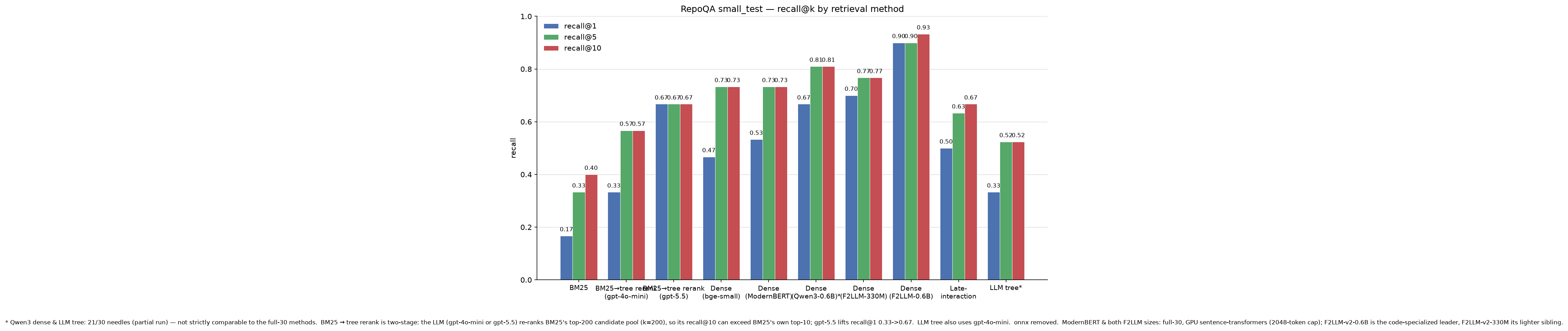
Retrieval methods on the RepoQA small_test split — each query is a
function description and the gold is that function (notebooks for most methods
live in notebooks/). Higher is better.
Method |
Config |
recall@1 |
recall@5 |
recall@10 |
MRR |
needles |
|---|---|---|---|---|---|---|
BM25 (keyword / FTS5) |
|
0.167 |
0.333 |
0.400 |
0.238 |
30 |
BM25 top-200 → tree rerank (2-stage, gpt-4o-mini) |
|
0.333 |
0.567 |
0.567 |
0.424 |
30 |
BM25 top-200 → tree rerank (2-stage, gpt-5.5) |
|
0.667 |
0.667 |
0.667 |
0.667 |
30 |
Dense (bge-small, 384-d) |
|
0.467 |
0.733 |
0.733 |
0.567 |
30 |
Dense (gte-modernbert-base, 768-d) |
|
0.533 |
0.733 |
0.733 |
0.601 |
30 |
Dense (Qwen3-0.6B, 1024-d) |
|
0.667 |
0.810 |
0.810 |
0.738 |
21* |
Dense (F2LLM-v2-330M, 896-d) |
|
0.700 |
0.767 |
0.767 |
0.725 |
30 |
Dense (F2LLM-v2-0.6B, 1024-d) |
|
0.900 |
0.900 |
0.933 |
0.906 |
30 |
Late-interaction (ColBERT / MaxSim) |
|
0.500 |
0.633 |
0.667 |
0.549 |
30 |
LLM tree reasoning (gpt-4o-mini) |
|
0.333 |
0.524 |
0.524 |
0.398 |
21* |
* Partial runs (21 of 30 needles) — indicative, not strictly comparable to the full-30 rows. These numbers come from ad-hoc runs across one session, not a single locked sweep; regenerate a clean, comparable sweep with the commands in §Running the benchmarks. The
onnxdense provider was removed;li_edgeonly has a partial run and is omitted. gte-modernbert-base, F2LLM-v2-330M, and F2LLM-v2-0.6B are full-30 runs served on GPU via sentence-transformers (2048-token cap,batch_size: 4for the F2LLM models), each in a dedicated process so CUDA memory is freed between embedders. BM25 → tree rerank is the lone two-stage method: the LLM (gpt-4o-mini or gpt-5.5) re-ranks BM25’s top-200 candidate pool (k=200), which is why its recall@10 can exceed BM25’s own top-10; the rest are single-stage. Swapping the reranker LLM to gpt-5.5 doubles recall@1 (0.33 → 0.67) — see §Reranker model: gpt-4o-mini vs gpt-5.5. (LLM tree also uses gpt-4o-mini.) Numbers are single-sourced inbaselines/method_comparison.json; this table cites it, and the chart is rendered from the same JSON byscripts/plot_method_comparison.py.
Takeaways. Vector methods clearly beat lexical BM25 (semantic vs. exact-term
matching); the code-specialized F2LLM-v2-0.6B embedder leads by a wide margin
(recall@1 0.90, recall@10 0.93), well ahead of the general-purpose
Qwen3-0.6B, with gte-modernbert-base mid-pack (it ties bge-small at
recall@10 but edges it at recall@1); dense (bge-small) and
late-interaction are close (LI edges bge at recall@1, bge leads at
recall@5/10); LLM tree reasoning works — once qualified_name is persisted
(schema v7) — but trails the vector methods on this split and is the most
expensive (one LLM call per query). BM25 → tree rerank roughly doubles BM25’s
recall@1 (0.17 → 0.33) and lifts recall@5 to 0.57 by re-ranking BM25’s top-200
candidate pool (k=200) with gpt-4o-mini — reaching tree-reasoning quality, still behind dense.
Upgrading that reranker to gpt-5.5 doubles recall@1 again (0.33 → 0.67) and lifts
recall@10 to 0.67, closing much of the gap to the mid-pack dense methods (see below).
Model size matters for F2LLM. The smaller F2LLM-v2-330M (896-d) lands at recall@1 0.70 / recall@10 0.77 (MRR 0.73) — clearly below its 0.6B sibling (0.90 / 0.93) but still topping the general-purpose Qwen3-0.6B and gte-modernbert-base at recall@1, at a slightly lower search latency (0.23s p50). So the code-specialized family wins at both sizes, but ~half the parameters costs ~0.16 recall@10 here.
Reranker model: gpt-4o-mini vs gpt-5.5¶
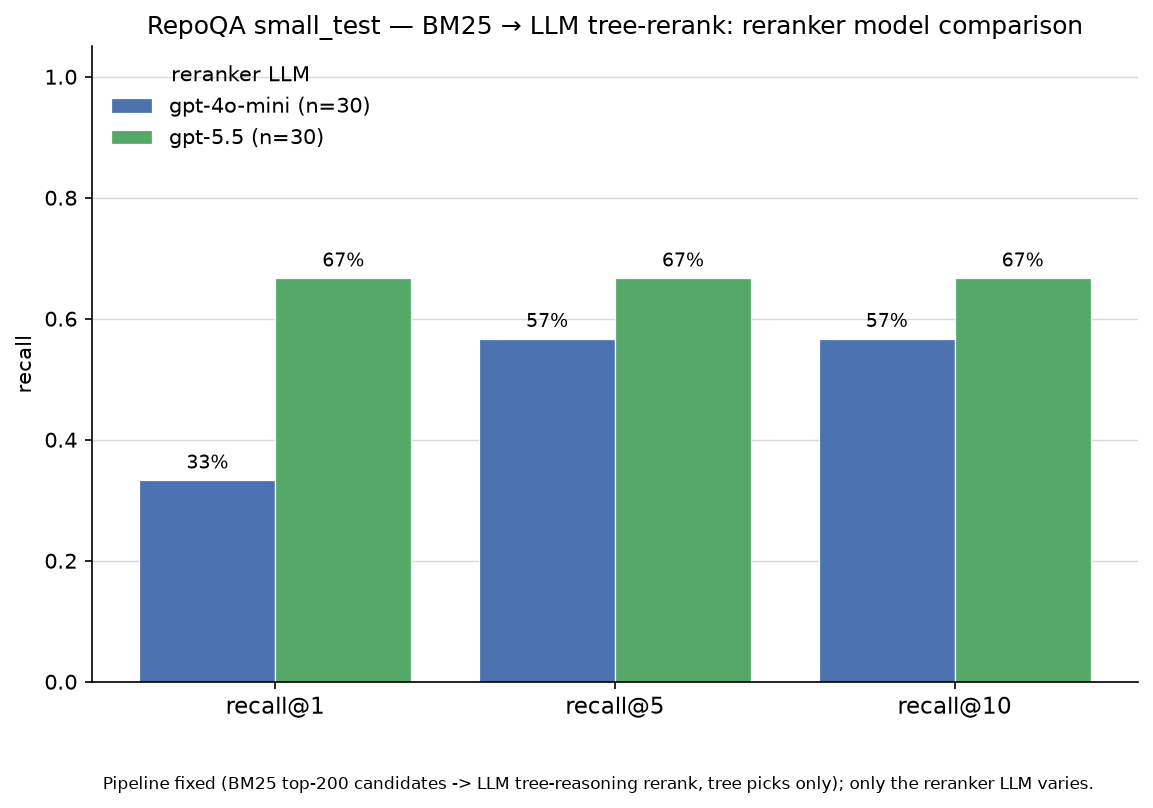
Holding the two-stage pipeline fixed (BM25 top-200 → LLM tree-reasoning rerank,
tree picks only) and varying only the reranker LLM, on the same 30-needle
small_test split:
Reranker |
recall@1 |
recall@5 |
recall@10 |
MRR |
search / needle (p50) |
|---|---|---|---|---|---|
gpt-4o-mini |
0.333 |
0.567 |
0.567 |
0.424 |
10.6s |
gpt-5.5 |
0.667 |
0.667 |
0.667 |
0.667 |
8.8s |
gpt-5.5 doubles recall@1 (0.33 → 0.67) and lifts MRR by +0.24. For gpt-5.5,
recall@1 = recall@5 = recall@10 = MRR: when it surfaces the gold it ranks it
first — no “buried at rank 2–10” cases — whereas gpt-4o-mini’s recall@1
(0.33) sits well below its recall@10 (0.57). Median latency is comparable
(gpt-5.5 slightly faster), but gpt-5.5 has a heavier tail (p99 ~43s vs ~17s) from
occasional long reasoning bursts. gpt-5.5 is a reasoning model, so its temperature
is forced to the model default (the client omits the unsupported temperature=0),
making its rerank mildly non-deterministic. Numbers are single-sourced in
baselines/reranker_model_comparison.json;
this table cites it, and the chart is rendered from the same JSON by
scripts/plot_reranker_model_comparison.py.
n=30 with a wide CI ([0.50, 0.83]) — the recall@1 / MRR gaps are large; the
recall@10 gap (+0.10) is smaller relative to that noise.
Quality vs. search latency¶
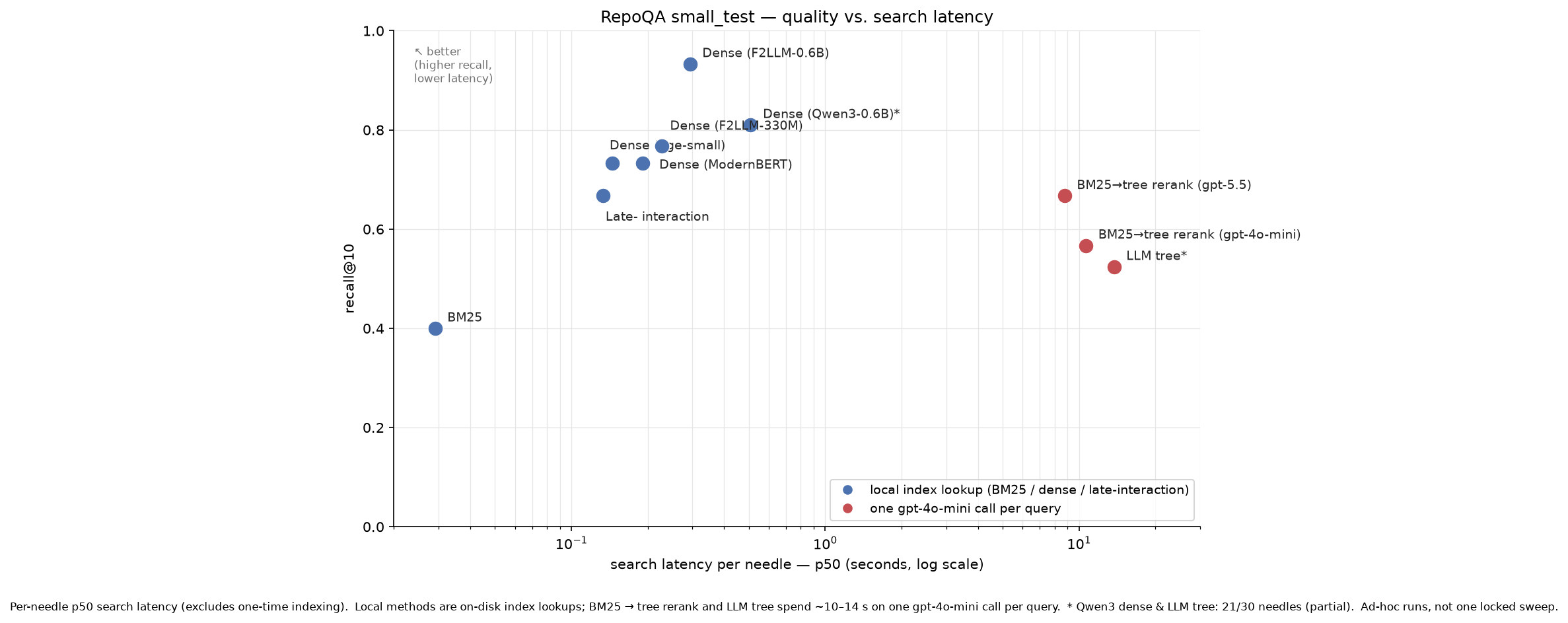
Per-needle p50 search latency (the query path only — excludes one-time
indexing), from each run’s per-task search_seconds:
Method |
recall@10 |
search / needle (p50) |
|---|---|---|
BM25 |
0.400 |
0.03s |
Late-interaction |
0.667 |
0.13s |
Dense (bge-small) |
0.733 |
0.15s |
Dense (ModernBERT) |
0.733 |
0.19s |
Dense (F2LLM-330M) |
0.767 |
0.23s |
Dense (F2LLM-0.6B) |
0.933 |
0.29s |
Dense (Qwen3-0.6B) |
0.810 |
0.51s |
BM25 → tree rerank (gpt-4o-mini) |
0.567 |
10.6s |
BM25 → tree rerank (gpt-5.5) |
0.667 |
8.8s |
LLM tree |
0.524 |
13.7s |
Two tiers: local index lookups (BM25 / dense / late-interaction) answer in
0.03–0.51 s, while the LLM methods (BM25 → tree rerank, LLM tree) spend
~10–14 s on one gpt-4o-mini call per query — a 20–450× gap. Dense
(F2LLM-0.6B) is now the dominant point (highest recall@10, 0.93, at 0.29 s),
beating Qwen3 on both quality and latency, so on quality-per-second the LLM
approaches are the weakest here.
Hybrid fusion sweep (F2LLM-v2-330M)¶
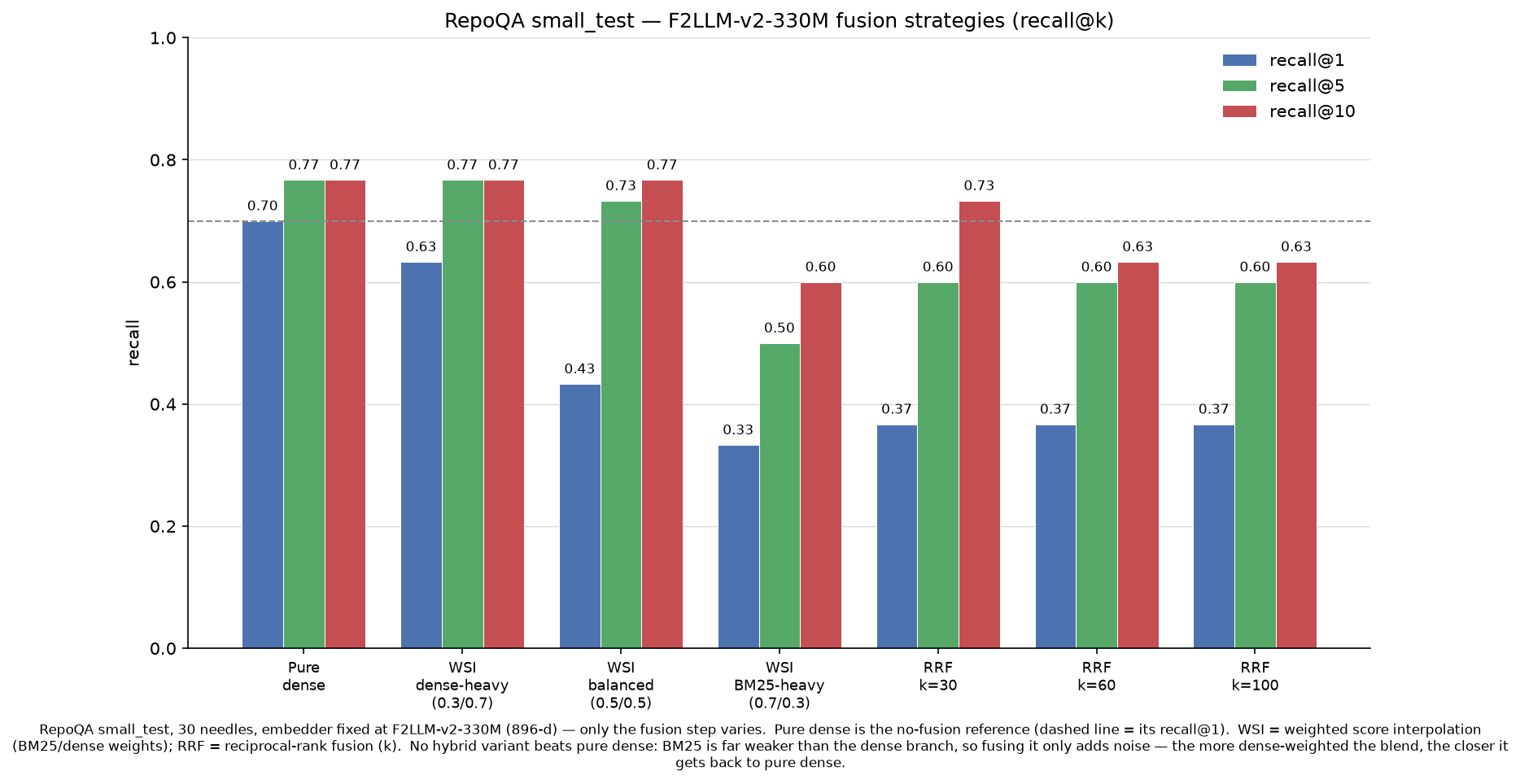
Does pairing the dense branch with BM25 help? We ran the same F2LLM-v2-330M
embedder through six fusion strategies on RepoQA small_test (30 needles) — only
the fusion step varies, so this isolates fusion from the embedder. None beat
pure dense.
Fusion |
Config |
recall@1 |
recall@5 |
recall@10 |
MRR |
|---|---|---|---|---|---|
Pure dense (no fusion) |
|
0.700 |
0.767 |
0.767 |
0.725 |
WSI dense-heavy (0.3 BM25 / 0.7 dense) |
|
0.633 |
0.767 |
0.767 |
0.674 |
WSI balanced (0.5 / 0.5) |
|
0.433 |
0.733 |
0.767 |
0.573 |
WSI BM25-heavy (0.7 BM25 / 0.3 dense) |
|
0.333 |
0.500 |
0.600 |
0.401 |
RRF k=30 |
|
0.367 |
0.600 |
0.733 |
0.481 |
RRF k=60 |
|
0.367 |
0.600 |
0.633 |
0.460 |
RRF k=100 |
|
0.367 |
0.600 |
0.633 |
0.460 |
All seven are full-30-needle GPU runs; p50 search latency is ~0.23 s across the
board (fusion is cheap — the cost is the dense embed, shared by all). Numbers are
single-sourced in baselines/hybrid_fusion_330m.json;
this table cites it, and the chart is rendered from the same JSON by
scripts/plot_hybrid_fusion_330m.py.
Takeaways. Pure dense wins. BM25 is far weaker than the code-specialized
dense branch (BM25 alone is recall@1 0.17), so blending it in mostly injects noise.
Within WSI (weighted score interpolation) recall tracks the dense weight
monotonically — dense-heavy (0.63) → balanced (0.43) → BM25-heavy (0.33) at
recall@1 — so the more you trust BM25 the worse it gets, and dense-heavy WSI only
approaches pure dense without passing it. RRF flattens to recall@1 0.37
regardless of k, because it keeps only ranks and discards score magnitude —
throwing away exactly the dense branch’s calibrated confidence. So for a strong
code embedder, skip fusion; if you must fuse, weight dense heavily and prefer
WSI over RRF.
Structural recall (graph expansion)¶
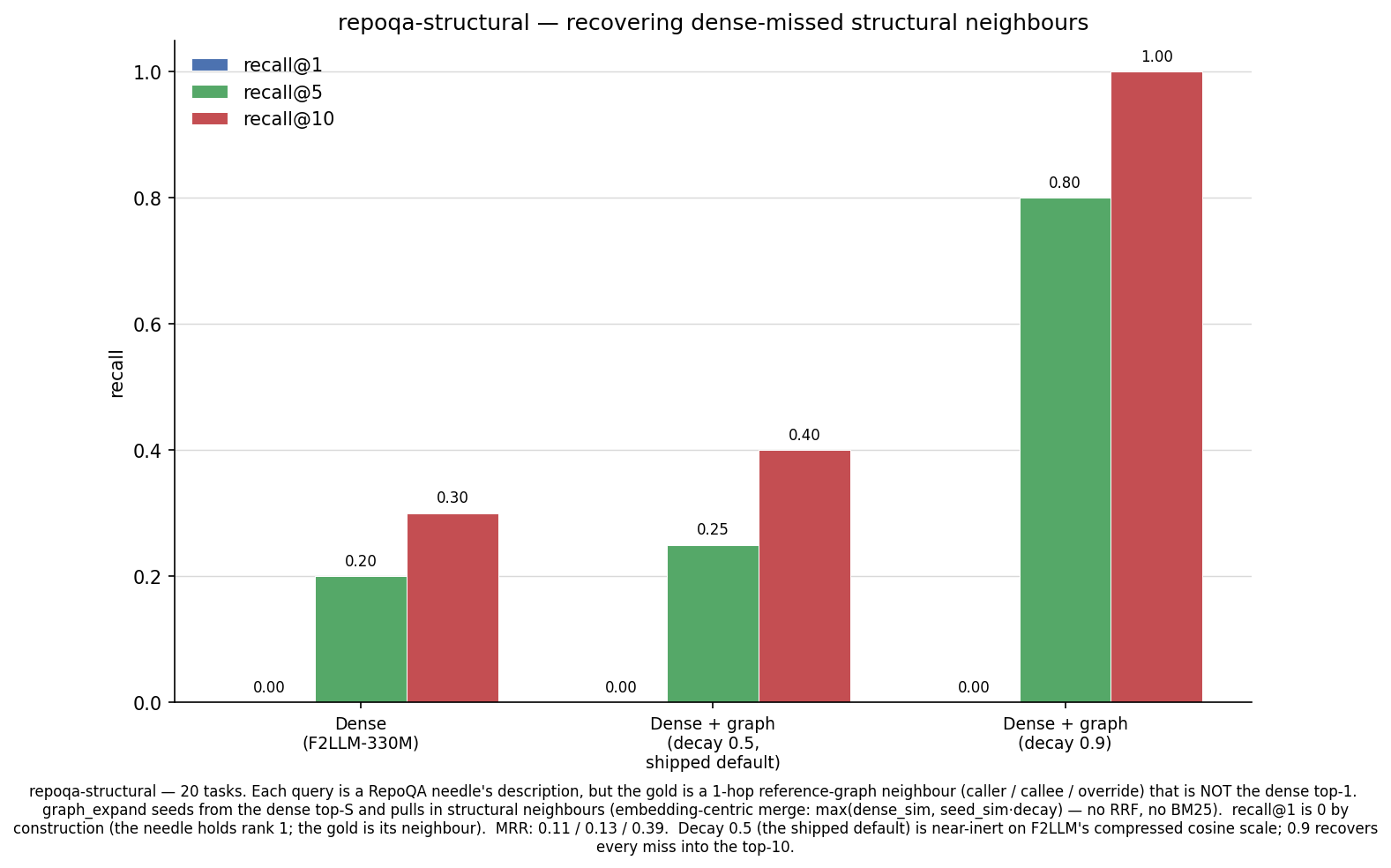
The repoqa-structural split isolates
what the graph_expand step adds: each query is a RepoQA needle’s description, but
the gold is a 1-hop reference-graph neighbour (caller / callee / override) that
dense retrieval does not rank first. Embedder is F2LLM-v2-330M (896-d) for
both columns — the only difference is the graph step. Higher is better.
Method |
Config |
recall@1 |
recall@5 |
recall@10 |
MRR |
tasks |
|---|---|---|---|---|---|---|
Dense (F2LLM-v2-330M, 896-d) |
|
0.00 |
0.20 |
0.30 |
0.113 |
20 |
Dense + graph (decay 0.5, old default) |
|
0.00 |
0.25 |
0.40 |
0.128 |
20 |
Dense + graph (decay 0.9) |
|
0.00 |
0.80 |
1.00 |
0.386 |
20 |
recall@1 is 0 by construction — the gold is a neighbour of the needle, and the needle itself holds dense rank 1, so the neighbour lands at rank ≥ 2; the meaningful metrics are recall@5/10 and MRR. The graph branch is embedding-centric: it seeds from the dense top-S and merges each discovered neighbour by
max(dense_sim, seed_sim·decay)— no RRF, no BM25. Numbers are single-sourced inbaselines/structural_recall.json(distinct from thefixtures/dataset file of the same name); this table cites it, and the chart is rendered from the same JSON byscripts/plot_structural_recall.py.
Takeaways. On the queries dense ranks poorly, a 1-hop graph expansion from the
dense hit recovers every miss into the top-10 (recall@10 0.30 → 1.00) and more
than triples MRR (0.11 → 0.39) at decay 0.9. The graph_expand decay knob is
decisive: the old default 0.5 is near-inert on F2LLM’s compressed cosine scale
(recall@10 0.30 → 0.40 only), so the shipped default is now 0.9. This is the
graph’s home turf — on the standard RepoQA split (where the gold is the
described function) pure dense already wins, and graph expansion only adds
neighbours below the answer, leaving recall@1 unchanged.
Graph-ranked default¶
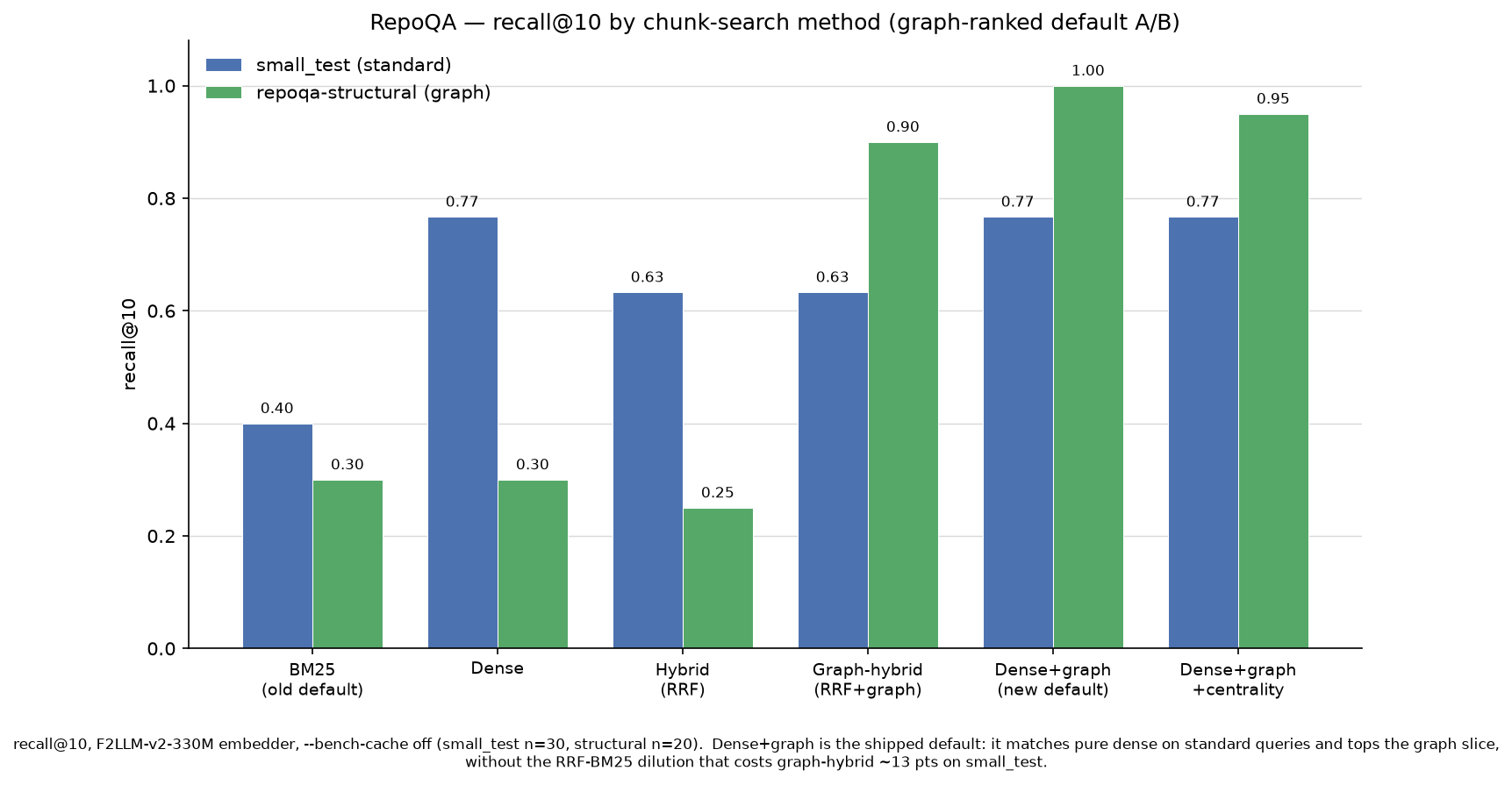
The two sweeps above settle the out-of-box default (previously BM25-only):
fusion doesn’t help a strong code embedder, and graph expansion transforms
structurally-reachable retrieval. This A/B runs six chunk-search methods across
both splits with the same F2LLM-v2-330M embedder (--bench-cache off).
Each cell is recall@1 / recall@10 / MRR:
Method |
Config |
small_test (standard, n=30) |
structural (graph, n=20) |
|---|---|---|---|
BM25 (old default) |
|
0.17 / 0.40 / 0.24 |
0.05 / 0.30 / 0.11 |
Dense |
|
0.70 / 0.77 / 0.73 |
0.00 / 0.30 / 0.11 |
Hybrid (RRF k=60) |
|
0.37 / 0.63 / 0.46 |
0.05 / 0.25 / 0.10 |
Graph-hybrid (RRF + graph) |
|
0.27 / 0.63 / 0.37 |
0.25 / 0.90 / 0.47 |
Dense + graph (new default) |
|
0.70 / 0.77 / 0.73 |
0.00 / 1.00 / 0.39 |
Dense + graph + centrality |
|
0.57 / 0.77 / 0.65 |
0.35 / 0.95 / 0.62 |
The recall@10 columns are single-sourced in
baselines/graph_default_ab.json; this table cites it, and the chart is rendered from the same JSON byscripts/plot_graph_default_ab.py.
Takeaways. dense + graph_expand is the new shipped default
(chunk_search_graph.yaml). It matches pure dense on standard queries (recall@10
0.77 — zero regression) and tops the structural slice (1.00), strictly
dominating the old BM25 default on both (0.40 → 0.77 standard, 0.30 → 1.00
structural). Two negative results pin down why it’s dense+graph and nothing
fancier: RRF-hybrid dilutes the strong dense branch (graph-hybrid drops to
0.63 on standard — the ~13-pt cost of mixing in weak BM25), and centrality
reranking hurts standard recall@1 (0.70 → 0.57, pushing the exact match below
the graph-central API). graph_expand is pure SQL (no [graph] extra), and the
default index already builds the dense .tq sidecar, so the flip adds no indexing
cost. The ordering also holds with the general-purpose bge-small default
embedder (dense recall@10 0.73 vs BM25 0.40 — see Method comparison), so the flip
helps out-of-box, not just with F2LLM.
Current baselines¶
Two baseline JSON files are tracked in benchmarks/baselines/:
File |
What |
Tasks |
recall@1 |
recall@5 |
recall@10 |
MRR |
|---|---|---|---|---|---|---|
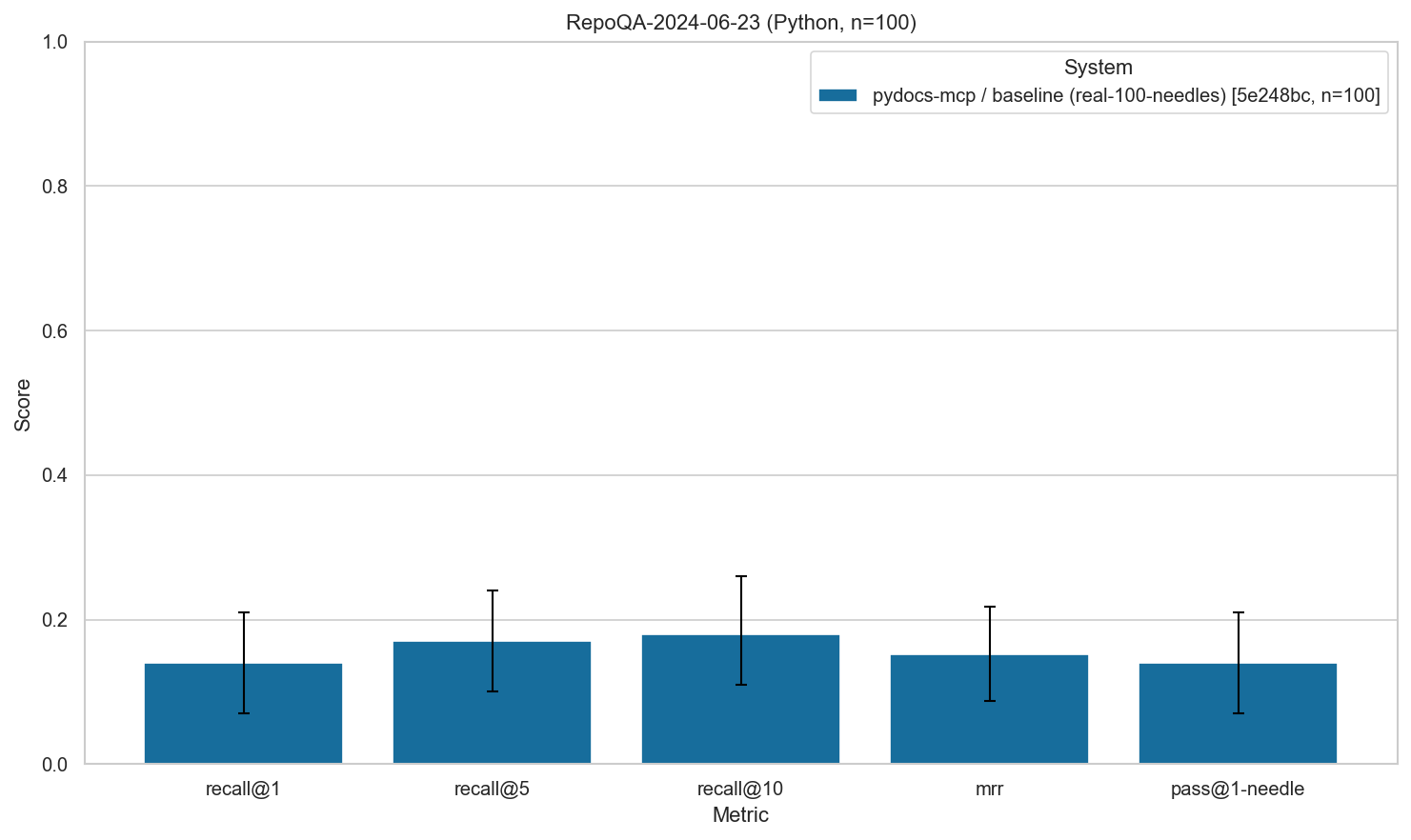
|
Real 100-needle sweep against the Python subset of |
100 |
14.0% [7%, 21%] |
17.0% [10%, 24%] |
18.0% [11%, 26%] |
15.2% [9%, 22%] |
|
5-needle hermetic CI gate fixture |
5 |
60.0% |
80.0% |
80.0% |
70.0% |
CIs are 95% intervals from bootstrap resampling (1000 iter, seed=0). Both were
captured against the chunk_search_ranked.yaml preset, which returns top-K
ranked separate chunks. The MCP server’s default (chunk_search_graph.yaml)
instead collapses to one composite chunk via token_budget_formatter (correct for LLM
consumers, but it structurally caps recall@k > 1 at 0 — there is only ever one
item to retrieve). The ranked preset drops the formatter so recall@k can
measure top-K hits.
The real-100-needle row is the headline figure. A dense + hybrid retriever
already ships in pydocs-mcp (the chunk_search_dense* / chunk_search_hybrid*
pipeline presets: an embedding-backed dense_fetcher for candidate generation,
RRF fusion, and a post-fusion dense_scorer re-rank) and works end-to-end in
both the MCP server and the benchmark harness
(the harness persists the dense .tq sidecar at index time). No dense baseline
has been recorded yet; when one is, it should beat recall@10 = 18% to be worth
adopting as the default.
Visualizing baselines¶
pydocs_eval.reporting.plotting turns baseline JSON files into figures. All commands
below assume the package is installed (see Install); from a source
checkout without installing, prefix them with PYTHONPATH=benchmarks/src.
Apples-to-apples constraint: every baseline in one figure must share the same
dataset field (e.g. all repoqa-2024-06-23-python). Mixing the 5-needle CI
fixture next to the real 100-needle sweep would misrepresent the numbers, so the
plotting functions raise ValueError listing the differing datasets. To compare
across datasets, plot each separately. The same commands work for DS-1000 once a
real sweep has produced a baseline JSON — substitute your own path and a
DS-1000 title.
Title convention: keep titles benchmark-focused (dataset + tasks) and let the
legend carry system / config / method names, so a chart still reads correctly
when a second bar group (e.g. a dense baseline) is added — no title rewrite
needed. Omitting --title defaults it to the first record’s dataset and
tasks_ran.
Score bars (recall@k, mrr, ndcg@10, …)¶
Grouped vertical bars: one colored group per baseline, one X-axis category per
metric, 95% CI error bars from each metric’s ci_low / ci_high. Default
palette is seaborn’s colorblind (colorblind-safe + Nature figure-guideline
compliant).
# Single baseline on the real 100 needles. Method is in the legend, not the title.
python -m pydocs_eval.reporting.plotting \
    benchmarks/baselines/repoqa_snf.json \
    --output benchmarks/results/plots/repoqa_real.png \
    --metrics recall@1,recall@5,recall@10,mrr,pass@1-needle \
    --title "RepoQA-2024-06-23 (Python, n=100)"

# Side-by-side compare on the SAME dataset: pass a second baseline JSON
# produced by another config's run — the plot picks up the second bar group
# automatically, no code change.
python -m pydocs_eval.reporting.plotting \
    benchmarks/baselines/repoqa_snf.json \
    benchmarks/results/your_second_baseline.json \
    --output benchmarks/results/plots/repoqa_real_compare.png \
    --title "RepoQA-2024-06-23 (Python, n=100)"
The legend identifies each system as
<system> / <config> (<label>) [<git_sha>, n=<tasks>], so a figure stays
self-describing when pasted into a PR description.
Programmatic API — same behavior, handy in a notebook:
from pathlib import Path
from pydocs_eval.reporting.plotting import plot_baselines

fig = plot_baselines(
    baselines=[
        Path("benchmarks/baselines/repoqa_snf.json"),
        # add further baseline JSONs here for side-by-side bar groups
    ],
    metrics=("recall@1", "recall@5", "recall@10", "mrr"),
    output=Path("benchmarks/results/plots/repoqa_real.png"),
    palette="colorblind",                       # also: "deep", "muted", "Set2"
    title="RepoQA-2024-06-23 (Python, n=100)",  # default: <dataset> (<tasks_ran> tasks)
)
The returned matplotlib.figure.Figure is yours to customize, .show(), or
re-.savefig() at a different DPI.
Timing bars (indexing + per-query latency)¶
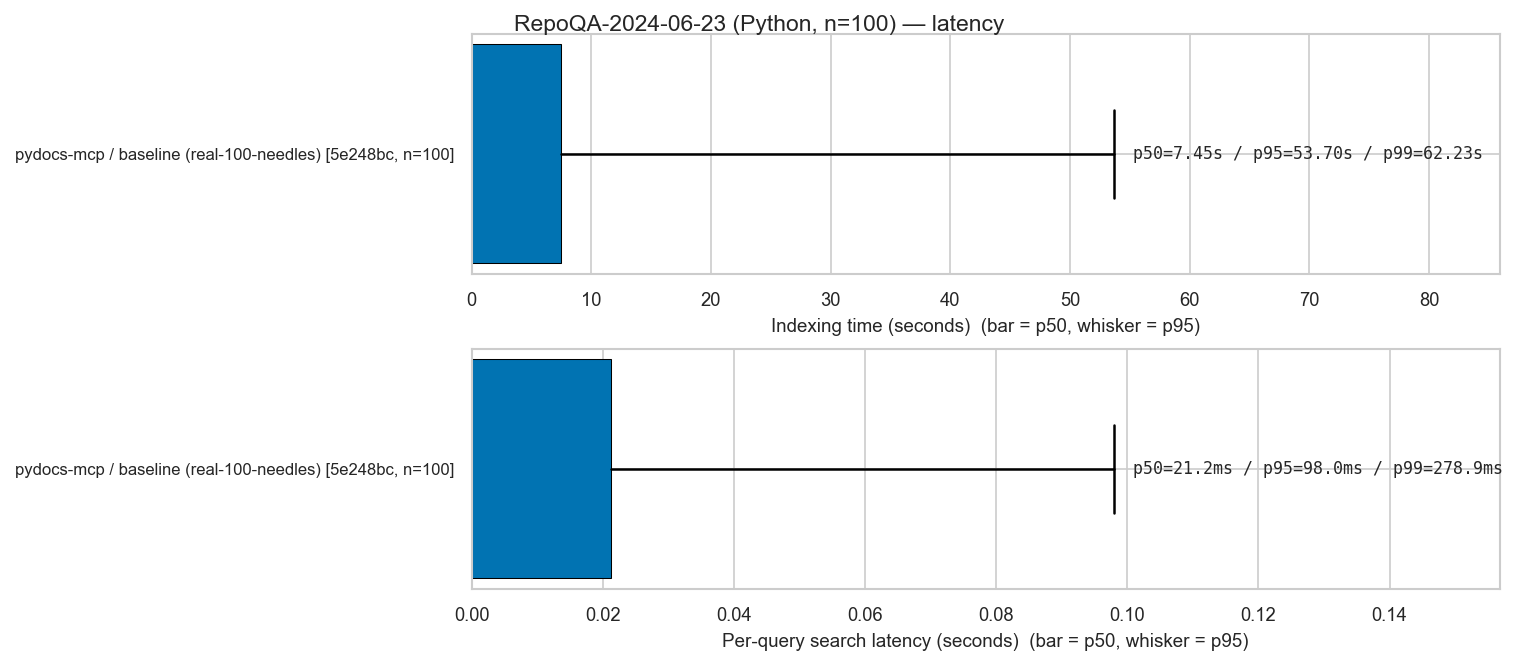
Latency lives on a duration scale with p50 / p95 / p99 percentiles, so
plot_timings() draws horizontal bars — one subplot per timing metric, so
indexing (seconds) and search (milliseconds) don’t get crushed onto one axis.
The bar marks p50, a whisker extends to p95, and the right edge is annotated with
the full p50 / p95 / p99 triple (µs / ms / s by magnitude).
python -m pydocs_eval.reporting.plotting \
    benchmarks/baselines/repoqa_snf.json \
    --output benchmarks/results/plots/repoqa_timings.png \
    --timings \
    --title "RepoQA-2024-06-23 (Python, n=100) — latency"
from pathlib import Path
from pydocs_eval.reporting.plotting import plot_timings

fig = plot_timings(
    baselines=[Path("benchmarks/baselines/repoqa_snf.json")],
    metrics=("indexing_seconds", "search_seconds"),   # default
    output=Path("benchmarks/results/plots/repoqa_timings.png"),
    palette="colorblind",
    title="RepoQA-2024-06-23 (Python, n=100) — latency",
)
Quality-vs-latency scatter (the Pareto view)¶
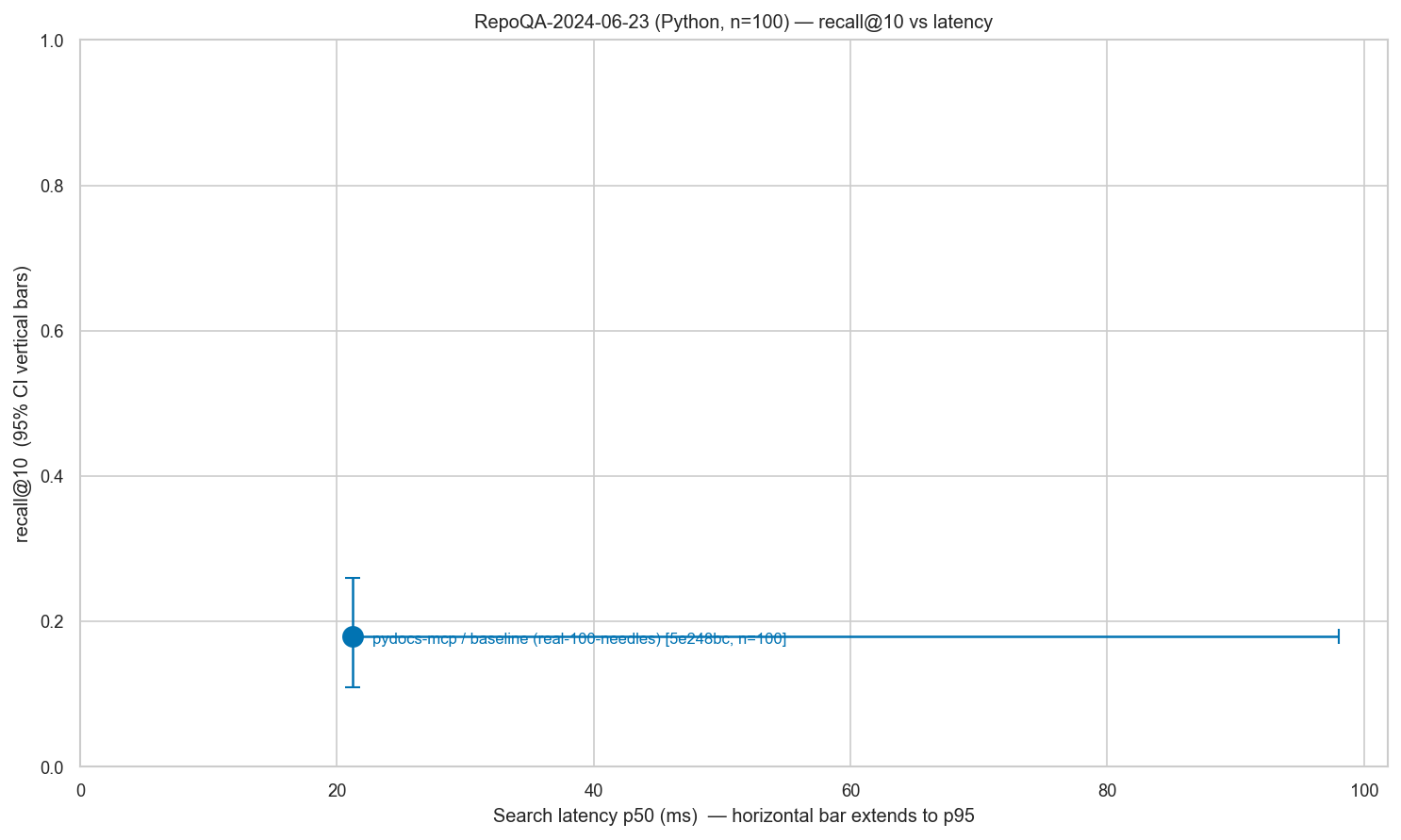
plot_metric_vs_latency() puts one point per baseline on a quality-vs-latency
chart — the classic IR trade-off. Y is a score metric (default recall@10) with
95% CI bars; X is a latency percentile (default p50 of search_seconds, in ms)
with a whisker to p95. Up-and-left is strictly better; up-and-right is the
trade-off line where dense / hybrid retrievers buy recall at higher latency.
# Today: a single dot (BM25 only). A recorded dense baseline adds a second dot.
python -m pydocs_eval.reporting.plotting \
    benchmarks/baselines/repoqa_snf.json \
    --output benchmarks/results/plots/repoqa_quality_vs_latency.png \
    --scatter \
    --scatter-metric recall@10 \
    --title "RepoQA-2024-06-23 (Python, n=100) — recall@10 vs latency"

# Swap the X-axis to indexing cost for a quality-vs-indexing-cost view.
python -m pydocs_eval.reporting.plotting \
    benchmarks/baselines/repoqa_snf.json \
    --output benchmarks/results/plots/repoqa_quality_vs_indexing.png \
    --scatter \
    --scatter-metric recall@10 \
    --scatter-latency indexing_seconds \
    --scatter-percentile p50
from pathlib import Path
from pydocs_eval.reporting.plotting import plot_metric_vs_latency

fig = plot_metric_vs_latency(
    baselines=[Path("benchmarks/baselines/repoqa_snf.json")],
    metric="recall@10",
    latency_metric="search_seconds",
    latency_percentile="p50",
    output=Path("benchmarks/results/plots/repoqa_quality_vs_latency.png"),
    title="RepoQA-2024-06-23 (Python, n=100) — recall@10 vs latency",
)
Point colors come from the same colorblind palette, so a baseline keeps its
color across all three plot types.
Running the benchmarks¶
Install¶
The suite publishes to PyPI as pydocs-mcp-eval (import package
pydocs_eval). Extras are split by coupling, not by feature: the base
install serves the black-box agent-efficiency track
(it drives the pydocs-mcp CLI as a subprocess, so it needs only that CLI on
your PATH for real runs — not the pydocs_mcp library), while the
retrieval-quality benchmarks and the optimizer import pydocs_mcp in-process
and live behind the [retrieval] extra.
# Agent-efficiency track. Needs the `pydocs-mcp` CLI on PATH for real runs
# (`pip install pydocs-mcp`); the base package itself does NOT pull it in.
pip install pydocs-mcp-eval

# + retrieval-quality benchmarks (RepoQA / DS-1000 systems) and the optimizer.
# The [retrieval] extra declares `pydocs-mcp` as a library dependency, so this
# one command installs it for you.
pip install "pydocs-mcp-eval[retrieval]"

pip install "pydocs-mcp-eval[mlflow]"       # + MLflow tracker (JSONL ships in base)
pip install "pydocs-mcp-eval[datasets-parquet]"  # + corpora published as parquet only
                                            #   (the bug-localization pair). Fixtures
                                            #   and the test suite need neither wheel.
pip install "pydocs-mcp-eval[all]"          # retrieval + mlflow + skillopt optimizer
Dev mode (editable, from a source checkout). pydocs-mcp is not a base
dependency, so a from-source dev setup is two steps — install the product
first, then the suite editable from the benchmarks/ subdirectory:
uv pip install -e ".[dev]"                  # the pydocs-mcp product (repo root)
uv pip install -e benchmarks                # the suite (agent track only)
uv pip install -e "benchmarks[retrieval]"   # + retrieval systems + optimizer
uv pip install -e "benchmarks[all]"         # everything
(pip works too — the extras are stock PEP 508.) The package follows the PyPA
src-layout (benchmarks/src/). Commands below assume it is installed; from a
bare source checkout, prefix any python -m pydocs_eval.… command with
PYTHONPATH=benchmarks/src.
Console commands. An installed environment also gets one console command
per module entry point — pure aliases, so every python -m pydocs_eval.…
invocation documented in this README keeps working unchanged:
Command |
Same as |
|---|---|
|
|
|
|
|
|
|
|
|
|
|
|
Running a sweep¶
The runner is a module entry-point. Each comma-separated config is one
AppConfig overlay (see benchmarks/configs/); the runner takes the matrix of
(systems × configs).
# Baseline run, pydocs-mcp only, against the bundled fixture (no network download).
./scripts/run_repoqa.sh \
    --systems pydocs-mcp \
    --configs <path-to-baseline.yaml> \
    --trackers jsonl \
    --fixture <path-to-fixture> \
    --limit 5

# Full sweep across config variants.
./scripts/run_repoqa.sh \
    --systems pydocs-mcp \
    --configs <baseline.yaml>,<no_stdlib.yaml>,<wide_chunks.yaml> \
    --trackers jsonl

# Equivalent direct invocation (and --help for the full flag list).
python -m pydocs_eval.runner --help

# View results in MLflow UI (requires the [mlflow] extra).
mlflow ui --backend-store-uri file://./benchmarks/mlruns/
For offline development, pass a --fixture JSON to bypass the RepoQA download
(see benchmarks/tests/fixtures/repoqa_mini.json).
DS-1000: prerequisites and the three runs¶
Prerequisites. The full (non-fixture) runs need two Hugging Face datasets (the loader pins a revision so a re-run fetches the same snapshot):
# The DS-1000 problems (queries + gold doc-ID annotations).
huggingface-cli download --repo-type dataset code-rag-bench/ds1000

# The library-documentation datastore (used by the oracle-indexing run).
huggingface-cli download --repo-type dataset code-rag-bench/library-documentation
The two native-pydocs-mcp runs also need the pinned reference project so the
indexer reads the exact library versions DS-1000 was authored against:
cd benchmarks/fixtures/ds1000_reference_project
python -m venv .venv
.venv/bin/pip install -e .
Its pyproject.toml pins the versions from DS-1000’s own environment.yml
(pandas 1.5.3, numpy 1.26.4, scikit-learn 1.4.0, …). Installing it materializes
those exact releases in site-packages, which pydocs-mcp then indexes — the
version-parity edge over Context7 and Neuledge, which serve whatever doc version
their service currently hosts. Context7, Neuledge, and the oracle run ignore
--corpus-dir (they query their own index or the datastore), so the reference
project is only needed for the two native runs.
Why three runs. The systems do not all emit the same output shape: Context7
and Neuledge return a single concatenated blob per query (rank-1 only), so
ranked metrics with k > 1 are undefined for them; pydocs-mcp can emit either
a single budgeted composite (matching that shape) or a ranked top-K list. The
three runs separate those concerns.
1. Cross-system comparison — matched single-blob output across all three systems:
python -m pydocs_eval.runner --dataset ds1000 \
    --systems pydocs-mcp-composite,context7,neuledge \
    --configs benchmarks/configs/composite.yaml \
    --metrics recall@1,mrr,precision@1,coverage,library_resolution@1 \
    --trackers jsonl
pydocs-mcp-composite selects the token-budgeted chunk_search.yaml (one
composite blob), compared apples-to-apples against Context7/Neuledge’s single
blob. Only recall@1 / precision@1 are meaningful here; library_resolution@1
scores Context7’s library-router accuracy and is 0.0 for the other rows.
2. Pydocs-only ranked — keep the ranked-list signal:
python -m pydocs_eval.runner --dataset ds1000 \
    --systems pydocs-mcp \
    --configs benchmarks/configs/ranked.yaml \
    --metrics recall@1,recall@5,recall@10,ndcg@10,mrr,precision@1,coverage \
    --trackers jsonl \
    --corpus-dir benchmarks/fixtures/ds1000_reference_project
The full ranked suite that needs k > 1 separate items. ranked.yaml
selects chunk_search_ranked.yaml (top-K separate chunks, no composite
collapse); --corpus-dir points the indexer at the reference project. For
calibration, CodeRAG-Bench reports DS-1000 NDCG@10 reference points of roughly
BM25 ≈ 5.2, GIST-large ≈ 13.6, Voyage-code ≈ 33.1; pydocs-mcp’s BM25-based
ranked preset should land in that range.
3. Oracle indexing — the canonical, CodeRAG-Bench-comparable run. This is
the standard DS-1000 retrieval eval: it mirrors CodeRAG-Bench’s own setup
(retrieval/create/ds1000.py) one-to-one, so the numbers are comparable to
their published reference points.
python -m pydocs_eval.runner --dataset ds1000 \
    --systems pydocs-oracle \
    --dataset-full-prompt \
    --configs benchmarks/configs/ranked.yaml \
    --metrics recall@1,recall@5,recall@10,ndcg@10,mrr,precision@1,coverage \
    --trackers jsonl
Three pieces make it canonical, matching the upstream builder:
Corpus = the documentation datastore.
pydocs-oraclewrites one chunk percode-rag-bench/library-documentationrow (preserving each doc’s identity in the chunktitle) instead of AST-extracting from source. The library is taken from each row’sdoc_idprefix (e.g.numpy.reference.arrays.scalars→numpy), since the rows carry only{doc_id, doc_content}.Ground truth = exact gold-title match. Relevance is exact membership of a retrieved chunk’s
titlein the task’s golddoc_ids — the same key the upstream qrels use (docs[*].titlematched against the corpusdoc_id). This isPydocsOracleGoldResolver; the fuzzy-content threshold of the native runs does NOT apply here.Query = the full prompt.
--dataset-full-promptsends the unstrippedprompt(NL problem + code stub) to the retriever, exactly as the upstream builder does (query = example["prompt"]). Without the flag the loader keeps only the NL question (a stricter, non-canonical variant).
Add --dataset-library-filter numpy for a fast single-library smoke. For
calibration, CodeRAG-Bench reports DS-1000 NDCG@10 reference points of roughly
BM25 ≈ 5.2, GIST-large ≈ 13.6, Voyage-code ≈ 33.1; the ranked.yaml
(BM25/FTS5) preset lands in the BM25 range. Secondarily, the gap between this run
and run 2 quantifies how much retrieval quality the AST-based source chunker
costs — run 3 is the ceiling with chunking removed.
Splitting and slicing (both deterministic):
# Tune on the dev partition, then evaluate on held-out test.
python -m pydocs_eval.runner --dataset ds1000 --split dev   ...
python -m pydocs_eval.runner --dataset ds1000 --split test  ...

# Restrict to specific libraries (case-insensitive, normalized).
python -m pydocs_eval.runner --dataset ds1000 \
    --dataset-library-filter pandas,numpy ...
--split {all,dev,test,small_test,small_dev} (default all) partitions each
library independently — preserving every library’s corpus proportion — into a
seeded dev head and test tail, so you can tune on dev without contaminating
the held-out test numbers. small_test and small_dev are fixed-size
(~30-task) Hamilton-apportioned stratified subsamples of the test tail and
the dev head respectively — same apportionment, same seed, same target size;
see Sweep protocol for which one a sweep should use.
The same --split applies to RepoQA (partitioned by repo).
--dataset-library-filter takes a comma-separated list matched against the
normalized (lower-cased) library name. --dataset-full-prompt (DS-1000 only)
queries with the unstripped prompt — the canonical CodeRAG-Bench query; omit
it to query with the NL question alone (the loader’s _strip_query default).
Indexing and caching¶
Indexing is one-time per RepoQA task. Each task ships its own repo slice, so
the harness indexes that slice into a SQLite cache on first touch and reuses it
for every subsequent query on the same task. The indexing_seconds row in a
baseline JSON measures that first-touch cost; search_seconds measures per-query
latency once the index is warm. The DB schema is described in the
project documentation.
That index is also persisted across sweeps and reused — see
Index cache below for how each
(corpus, ingestion-config) is indexed once and shared across conditions and
re-runs, and how to inspect or clear it.
Index cache (faster repeated sweeps)¶
Each (corpus, ingestion-config) is indexed once and reused across tasks
and across sweeps that share an ingestion pipeline. Controlled by
--bench-cache on|off (default on). The cache lives at
~/.pydocs-mcp/bench/ (outside the repo).
# inspect / clear the cache
python -m pydocs_eval.bench_cache_cli info
python -m pydocs_eval.bench_cache_cli evict

# run all experiments, then free the disk (cache used during the run,
# wiped when it finishes — even if the run errors)
python -m pydocs_eval.runner --bench-cache-cleanup ...

# reproduce pre-cache numbers exactly
python -m pydocs_eval.runner --bench-cache off ...
The cache key folds the ingestion pipeline hash, so changing the embedder
or the ingestion YAML rebuilds automatically. A change to the corpus
contents under the same path is NOT auto-detected — run bench_cache evict or --bench-cache off after editing a corpus in place.
--bench-cache-cleanup evicts the WHOLE cache at the end (not just this
run’s entries) — don’t pass it while a concurrent sweep shares the cache.
Reading indexing time: a cache HIT makes index() a ~0 s lookup, so
warm tasks record NO indexing_seconds (the metric would otherwise read
“0.0 s”). Take true indexing-time numbers from a COLD run — the first
sweep after bench_cache_cli evict, or any --bench-cache off run. Warm
sweeps still give correct quality + search_seconds. The sweep is
sequential (one task at a time, no concurrency), so a cold run’s timing
is uncontended.
Running the tests¶
uv pip install -e "benchmarks[all]"
pytest benchmarks/ -q
The whole suite is hermetic — the bundled fixtures
(benchmarks/tests/fixtures/: repoqa_mini.json, ds1000_mini.json,
ds1000_50.json) let it run with no network, Hugging Face download, or
reference-project venv. DS-1000 coverage lives under
benchmarks/tests/, including: the dataset loader and NL-strip
(test_ds1000_dataset.py); the stratified dev/test split
(test_ds1000_split.py, test_split_helper.py, test_ds1000_stratified_fixture.py);
the metrics (test_recall_at_k.py, test_ndcg_at_k.py, test_precision_at_1.py,
test_coverage.py, test_library_resolution_metric.py,
test_recall_mrr_repoqa_fallback.py, test_is_relevant.py); the relevance layer
(test_gold_resolver.py); the composite + oracle systems
(test_pydocs_composite_mode.py, test_pydocs_mcp_composite_variant.py,
test_pydocs_oracle_system.py, test_context7_oracle.py,
test_integration_oracle.py); the AppConfig overlays (test_ds1000_configs_load.py,
test_ds1000_reference_project_fixture.py); and the end-to-end smoke across all
three runs (test_ds1000_smoke.py).
License and attribution¶
Per-benchmark licensing + citation lives in the relevant subsection under Datasets (each benchmark cites its own source). Cross-cutting:
MLflow — Apache-2.0, Databricks. Experiment-tracking backend; the tracking URI defaults to a local
file://store, so no remote server is required.seaborn / matplotlib — BSD-3-Clause, used for the plotting module.
Third-party attribution lands in
LICENSE-third-partyonce it is added.